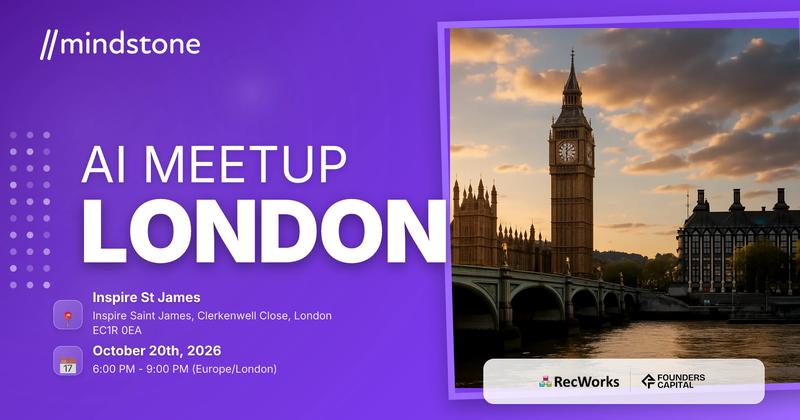
Mindstone London October AI Meetup header image
Mindstone London October AI Meetup

Welcome to the biggest Practical AI Meetup in London!

Join us once a month as we explore the world of artificial intelligence, its cutting-edge practical applications, and the astonishing projects that are shaping our future.

Why should you attend?

  • Get up close and personal with the AI projects that are redefining the boundaries of technology and human potential.
  • Learn from the brightest minds in the field and gain valuable insights into the ever-evolving AI landscape.
  • Unleash your curiosity, fuel your creativity, and expand your network as you connect with fellow AI aficionados and pioneers.

What you can expect?

Mindstone events consist of three talks covering different aspects:

  • What I Learned Building With LLMs: A technical talk breaking down the process for building a product using AI with real-life learnings and insights.
  • How To Be More Productive Using AI: A practical demo and step-by-step guide on how to use AI to speed up and improve tasks.
  • What Does The Future Look Like With AI?: A theoretical talk on the impact of AI on work, life and society.

After the talks we'll have pizza, drinks, and time to connect with everyone around you.

Don't miss the opportunity to see what's really happening in AI - you'll be surprised at what's already possible today.

We have limited spots available, so get your ticket ahead of time to avoid disappointment!

Agenda
Doors Open
Welcome to the event
Introduction
Welcome and event introduction
Using AI? What You Need to Know About Protecting Your Ideas by Anna Orchard
AI has made it easier than ever to design, develop and enhance new and existing products, brands and businesses. Many founders and creators often overlook one important question: how do you protect what you are creating? In this accessible introduction to intellectual property, Anna Orchard, a Trade Mark Attorney at Williams Powell, will explain the different types of IP and their significance for AI businesses, software products and emerging brands. The talk will use real-world examples to show how not addressing IP can become costly when not considered early enough.
View recording
Controlling AI: Emerging Approaches to Making It Follow Your Rules by Maury Shenk
AI tools can be powerful but unpredictable. They can make things up, get tricked, and nobody fully understands why they answer the way they do. So how do businesses make sure an AI follows their rules, whether that's company policy, the law or their values? Maury Shenk, CEO of Ordinary Wisdom, gives a plain-English tour of the main approaches being tried today, from retraining the AI itself to putting guardrails around it. You'll leave knowing the questions to ask before trusting an AI with something important.
View recording
Building an Events Platform with AI: The Hard Part Was Keeping It Simple by Rhys Morris
AI helped Rhys Morris turn fifteen years of event experience into the concept and architecture behind TRM Flex. But as the platform grew from staffing into connected event delivery, he hit a problem many builders will recognise: a system that makes sense to its creator can still be hard for everyone else to use. Rhys will share how he used visual workflow maps and reusable AI advisor skills to develop the product, how complexity crept in along the way, and how he's now simplifying so core tasks are easier to understand and complete. Using a real workflow and a proposed simplification, he'll show what he learned. You'll leave knowing how to challenge an AI-assisted build, separate essential tasks from optional features, and test for clarity beyond your own familiarity with the product.
View recording
Wrap Up
Closing remarks and next steps
Pizza, Drinks & Networking
Casual networking with food and drinks
Speakers
Answered questions

Talk: Using AI? What You Need to Know About Protecting Your Ideas

Question

How does IP protection apply when AI models are used to replicate/decompile existing software prducts? Are the LLM users liable or the model providers?

Asked by [email protected] @patrickm2092727385

Answer

Yes, IP protection would apply. This is dependent on the countries involved and their national law and is something ISPs have battled for many years on whether they are liable for users acts. Generally, courts have found users and not service providers liable but this is being changed in some countries to make service providers more responsible/police their users. Replication would still infringe some's IP even if AI was used. It is likely to be the person giving the commands to be found to infringe. Similarly, overcoming protection measures is a form of copyright infringement in many countries.

Answered by Anna Orchard

Talk: Using AI? What You Need to Know About Protecting Your Ideas

Question

What about creating new businesses with Claude or ChatGPT - Can you protect your IP and how do you protect yourself from the labs using your IP?

Asked by [email protected] @kimt797294103

Answer

Use commercial versions of the tools and instruct them not to store data or prompts or use them in future training. This should keep what you are inputting confidential (worth checking terms and conditions of whatever LLM you use but generally commercial contract includes duty to keep inputs confidential). You can protect concepts in the same way as if you had come up with the idea without using LLMs - copyright will happen automatically, you can apply for patents and trade marks etc. If you think there is value in registering for the business, get professional advice as using an LLM hasnt changed the rest of the process.

Answered by Anna Orchard

Talk: Controlling AI: Emerging Approaches to Making It Follow Your Rules

Question

Are we not limiting the functionality by putting guardrail around LLM?

Asked by [email protected] @mohas5900282294

Answer

Yes, we are limiting functionality. That is the point of guardrails. The point of your question may be that guardrails also limit desired capabilities. This may be true to some extent, but it appears to be a relatively small effect.

Answered by Maury Shenk

Talk: Controlling AI: Emerging Approaches to Making It Follow Your Rules

Question

With the shift from simple LLMs to autonomous AI agents acting on their own, the 'black box' problem is compounding. How much time and engineering effort should actually be spent on guardrails versus core capabilities, and can we even realistically control multi-agent systems?

Asked by [email protected] @alexanderf8315913899

Answer

Both core capabilities and guardrails deserve attention. Consider a hammer -- it appears impossible to prevent it from being used as a weapon by changing its 'core capabilities'. So we need to depend upon restraints on its use. Controls on multi-agent systems are indeed challenging, but I am confident that these will improve over time, subject to the challenge that agent capabilities will be improving at the same time.

Answered by Maury Shenk

Talk: Controlling AI: Emerging Approaches to Making It Follow Your Rules

Question

If LLMs are fundamentally probabilistic, how can we achieve deterministic control over their behaviour? Can guardrails guarantee compliance, or do they only reduce the probability of failure?

Asked by [email protected] @rajg7690610265

Answer

It depends upon the situation. For some types of problems (e.g. does this LLM answer talk about a prohibited subject?), guardrails can get to or near 100% compliance. In other cases, guardrails may only be limiting the probability of failure. But that is a significant contribution if the reduction in probability is large, and may significantly reduce risk. In many societal domain, quantum of risk is a key consideration.

Answered by Maury Shenk

Talk: Controlling AI: Emerging Approaches to Making It Follow Your Rules

Question

For autonomous agents with tool access, how do you enforce security policies at the tool execution level, rather than just filtering prompts and responses? And how do you measure the effectiveness against multi-step attacks?

Asked by [email protected] @adamc437511584

Answer

This is a very complex problem to which the market does not yet have an answer. There are some partial answers like blocking access to particular tools, or blocking Internet access completely (or severely limiting it). Also, the response depends upon the specific attack.

Answered by Maury Shenk

Talk: Controlling AI: Emerging Approaches to Making It Follow Your Rules

Question

What guardrail methods will stay relevant as AI capabilities scale?

Asked by [email protected] @shahira2283012076

Answer

The future is hard to predict! I expect that current guardrail methods will evolve steadily, and new approaches will emerge. Methods may also generalize. For example, providing additional context is likely to be a durable guardrail, but embeddings-driven RAG may play a lesser role over time in providing context.

Answered by Maury Shenk

Talk: Controlling AI: Emerging Approaches to Making It Follow Your Rules

Question

With feedback methods, what happens upon failure of the prompt output? Regeneration of the output?

Asked by [email protected] @antonj5431865118

Answer

Various options are possible. The main ones are (1) modifying the output (regeneration is one way to do this) and (2) refusing to answer (the main approach of leading models).

Answered by Maury Shenk

Talk: Controlling AI: Emerging Approaches to Making It Follow Your Rules

Question

why do we need to pace the frontier if controlling it seems feasible?

Asked by [email protected] @LukasEndl90

Answer

Pacing the frontier and controlling models are two different solutions to AI risks. Both may have a role.

Answered by Maury Shenk

Talk: Controlling AI: Emerging Approaches to Making It Follow Your Rules

Question

If I set an instruction for my agent asking it to not hallucinate, does it know what it means truly?

Asked by [email protected] @maithreyib5255947066

Answer

I do not believe that it is possible to effectively tell an AI model not to hallucinate. Hallucination controls need to be external to the model -- see this Satya Nadella post: https://x.com/satyanadella/status/2108931348857827686. Such external controls are what we are building at Ordinary Wisdom.

Answered by Maury Shenk

Talk: Using AI? What You Need to Know About Protecting Your Ideas

Question

Japan has taken a very open approach to AI, allowing companies to train models on copyrighted data without needing prior permission from creators. What is your perspective on this approach compared to the stricter rules being introduced in Europe and the US?

Asked by [email protected] @alexanderf8315913899

Answer

While Japan is more permissive, there are exceptions to what is permitted and its not a clear "no risk" situation. https://www.ibanet.org/Japans-AI-training-exception Very few countries have identical IP laws and approaches and even when they do, government policy and/or commercial attitudes and services tend to force them to come closer together over time. I'd expect the stricter approaches to win on this over time.

Answered by Anna Orchard

Talk: Using AI? What You Need to Know About Protecting Your Ideas

Question

What about China? Aot of infringements are from there.

Asked by [email protected] @doronl3996347318

Answer

China can be a challenging market, both to companies from outside wanting to enter their market and also from products and services originating from China. Having IP helps. You can obtain IP in China to protect your activities there and also in other countries to protect imports from China. Its not a new challenge, but it is one where businesses have successfully used IP to defend what is theirs for many years and AI will not change that.

Answered by Anna Orchard

Talk: Using AI? What You Need to Know About Protecting Your Ideas

Question

What do you recommend for “vibecoded” apps -> when/what to check, when to register, biggest risks?

Asked by [email protected] @LukasEndl90

Answer

Vibecoding gets you to a product/service/market quicker than historic routes but still has the same risks and opportunities. I'd recommend you ignore how you got to the product/service at it doesn't matter to IP. Look at what differentiates you from competition, what someone else might want to copy and work out if the business can support the cost of IP registration and if it would benefit from the IP. If so, get professional advice. If there are big or aggressive businesses in the field, you need to look at what they are doing/think is theirs as those tend to be the biggest risks to a new entrant.

Answered by Anna Orchard

Talk: Using AI? What You Need to Know About Protecting Your Ideas

Question

If I am using Claude/ ChatGPT to brainstorm business ideas and take it further, who has the intellectual rights to the business idea?

Asked by [email protected] @maithreyib5255947066

Answer

You need to look at the terms and conditions of the system you are using. This is also relevant on whether they can take the data you input and use it for future training etc. Generally, if you are the originator/creator of a work that has IP you are the first owner of the IP rights. However, by inputting it into a system you might (depending on the terms and conditions) be giving other parties rights to use your IP. You might also be disclosing your concept (bad if you are thinking of applying for a patent).

Answered by Anna Orchard

Talk: Using AI? What You Need to Know About Protecting Your Ideas

Question

I have heard of other areas of IP like trade secrets what are they and do they relate to software?

Asked by [email protected] @anastasiah6409629147

Answer

Trade secrets are also referred to as "knowhow". They are protected through confidentiality/secrecy but don't give you any ability to stop someone who independently has the same knowledge/idea. Trade secrets are valuable and are grouped under "IP" when you give someone a license etc but they aren't formally protected, just useful information you might have documented or in your head. It doesn't really relate to software as any software will also have copyright, although the knowhow on configuring a server or database for the software might fall in this category.

Answered by Anna Orchard

Talk: Using AI? What You Need to Know About Protecting Your Ideas

Question

There is a small side project that i started few months ago. It is published in GitHub under free MIT license. The project is growing and want to start a company to continue working in this project as a business. How can i convert IP wrights from MIT license to private? Is it possible at all?

Asked by [email protected] @Eugen

Answer

My understanding is that GitHub allows a change in license type/conditions for future branches and new downloads but that you cannot retroactively change the license (so anyone who has downloaded the code or who creates a new branch or project themselves would be able to do so under the MIT license).

Answered by Anna Orchard

Attendees
Location
Get involved in London

Help bring more practical AI events to your city.

Become a Mindstone Associate

Help us grow your local community.

Volunteer at an event

Lend a hand on the night — no commitment.